Get Regular Market Updates

Like what you read below?

Stay informed. Don't miss critical market insights, specific to St. John's and the surrounding communities, from an experienced, local Realtor® 

What’s happening in the market today?

RSS

The History of a Property and Why it Matters: 201 Waterford Bridge Road

I spent more time researching this listing than I did writing the overview. It wasn't even close.

But when I'm recording voiceovers for cinematic property video, that's exactly what I'm looking for: substance behind the content. I don't want to simply describe what someone can already see on the screen. I want to understand what makes the property interesting and, where possible, tell some of the story behind it.

With 201 Waterford Bridge Road, that started with what I thought would be a simple question: How old is the house?

201 Waterford Bridge Road underwent an extensive renovation completed around 2010, and much of what you see today reflects that work. At the same time, there are details throughout the house that clearly point to an earlier history. Some are subtle, but the most obvious are the four ornate fireplaces distributed throughout the home - a feature that makes considerably more sense when viewed as part of an earlier era in which fireplaces played a much more important role in heating a house.

Previous MLS records referenced an original construction date of 1945. The municipal permit from 2008 was classified as a renovation but didn’t provide further details of age, and the history passed along with the property is that the existing house was extensively stripped back and rebuilt, ultimately producing the home that exists today.

So, what was there before that? I haven't found a record that allows me to definitively establish when the original house at 201 was constructed, and I'm not going to turn historical clues into facts simply because they make for a better story. What the search did, however, was lead me into the much older history of Waterford Bridge Road itself.

One thread led to an estate known as Summervale, a substantial 22-acre property documented on Waterford Bridge Road in the 19th century. The historical references I've found place it somewhere west of Waterford Manor, which is well documented at 185 Waterford Bridge Road, and east of Waterford Bridge. That description puts Summervale somewhere within the broader area I'm interested in, although I have not found anything that definitively connects it to the land at 201.

By the early 20th century, records describe Summervale as far more than a single residence. It was a functioning agricultural property containing farmland, multiple dwelling houses, stables, barns and other outbuildings, along with livestock, crops and agricultural equipment.

Could the land now known as 201 Waterford Bridge Road once have formed part of Summervale, or emerged from the eventual breakup of one of these larger estates? It's an intriguing possibility, but I haven't found the documentary link that would allow me to say that it did.

What we do know is that this was a remarkable stretch of Waterford Bridge Road. Just down the road, at 185 Waterford Bridge Road, stood Waterford Manor, also known as Waterford Hall. Built in 1905 and designed by noted Newfoundland architect William F. Butler, the three-storey Queen Anne Revival mansion passed through the hands of several significant figures in Newfoundland's history.

Sir Edgar Rennie Bowring, a leading member of the Bowring merchant family, Newfoundland legislator and later Newfoundland's High Commissioner in London, owned the property. He is also closely associated with the creation of Bowring Park, having provided the funds for its establishment.

In 1929, Bowring sold Waterford Manor to Major Peter Cashin, former Newfoundland Minister of Finance and later one of the most prominent anti-Confederation voices during the National Convention debates of 1946–48. The Cashin family sold it in 1936 to Robert B. Job, president of the historic mercantile firm Job Brothers & Co., who would himself serve in Newfoundland's National Convention and advocate for a return to responsible government.

These weren't simply wealthy occupants of an impressive house. Their business and political lives intersected with some of the defining chapters of Newfoundland's pre-Confederation history. Waterford Manor had another remarkable chapter as well. During the First World War, it was used as a convalescent home for sick and wounded soldiers. The building survived for more than a century before being lost to fire in 2016.

None of that establishes the history of the house at 201 Waterford Bridge Road, but it does establish something important: the history of the place around it. Long before modern St. John's grew around the Waterford Valley, this was already a corridor of substantial homes, estates, farmland and institutions. That history provides some context for why properties along Waterford Bridge Road don't necessarily resemble the neighbourhoods that later developed around them. Parcels can be unusually deep, boundaries can be irregular, houses reflect different periods of development, and mature properties extend from the road toward the Waterford River.

It also makes the unanswered question at 201 more interesting. Working backward through the known history of the house eventually reaches a dead end. We know it underwent a major transformation around 2008–2010. We know there was an existing house there to renovate. Previous real estate records suggest an earlier construction date, but I haven't found the documentation needed to establish exactly when that house was built or what preceded it.

Approaching the question from the opposite direction - starting with the established properties of the 19th century and working forward - brings us back to Summervale. And this is where its history becomes particularly interesting.

In her 1907 will, Jane Elizabeth Graham, owner of Summervale, described the property in considerable detail: farmland and premises on Waterford Bridge Road together with dwelling houses, stables, barns and other outbuildings, as well as horses, cattle, agricultural implements and crops. Graham left Summervale to her daughter, Hannah Graham, for the duration of Hannah's life, but her will contained a specific instruction about what was to happen afterward. Upon Hannah's death, the Summervale farm, dwelling house and premises were to be advertised and sold, with the proceeds divided among Jane Graham's surviving grandchildren. Hannah lived for another three decades and died in 1942 at the age of 86.

That creates a potentially important turning point in the history of Summervale around 1942–43, which is close to the timeframe that has been estimated in previous MLS records. Rather than simply passing intact to another generation, the property was directed by Jane Graham's will to be sold. What I haven't yet located is the subsequent conveyance that would tell us precisely what happened to those lands after Hannah's death - whether Summervale was sold intact, divided at the time of sale, or subsequently broken into smaller parcels. And if one of those potential parcels or buildings could be linked to 201. 

There is another intriguing clue in the earlier record. An 1898 directory identifies Robert Dawe, a farmer, at “Summervale Cottage.” That fits remarkably well with Jane Graham's later description of Summervale as containing not simply one residence, but multiple dwelling houses within a working agricultural property.

It's tempting to start joining those dots. The problem is that the evidence doesn't yet allow us to do it. Nothing I've found proves that the land now known as 201 Waterford Bridge Road formed part of Summervale. It doesn't establish that one of the dwelling houses described on the estate became the house at 201, nor does the direction to sell Summervale after Hannah Graham's death establish that the resulting sale created the parcel we see today.

Those are missing links, and they matter. Without them, I can't claim to know the true age or origin story of 201 Waterford Bridge Road. What the records do reveal is something broader and, in many ways, just as interesting.

By the late 19th and early 20th centuries, this wasn't simply undeveloped land waiting for St. John's to reach it. There were substantial estates and working farms here, with multiple residences and outbuildings spread across large properties. Waterford Manor tells another part of the same story: an extraordinary residence occupied over time by some of Newfoundland's most prominent business and political figures.

That history helps explain something you can still feel along Waterford Bridge Road today. The properties don't always conform to the pattern of the neighbourhoods that eventually grew around them. Their boundaries can be unusual, their lots exceptionally deep, and houses from different periods sit among mature landscapes, with some properties stretching all the way toward the Waterford River.

The modern city grew around a much older landscape. Whether the history of Summervale and the history of 201 Waterford Bridge Road ever intersect is a question I haven't answered - at least not yet.

For me, that has been one of the most interesting parts of preparing 201 Waterford Bridge Road for market. The research hasn't given me the tidy origin story I initially went looking for, but it has given me a much better understanding of the place this house occupies and the history that surrounds it.

Take a closer look at this remarkable property and the home that stands there today by clicking the link below.

201 Waterford Bridge Road
St. John's, Newfoundland & Labrador
MLS® 1303482
$1,300,000

Read

The Big Picture: BOMA Conference Insight on Newfoundland Real Estate Market

Recently, I attended the BOMA NL Real Estate Forum listening to updates from across the industry - residential and commercial Realtors®, economic forecasts, and one of the top developers in the province. The general gist of the event is that industry experts are brought in to provide opinions on the state of the market to building owners and managers to inform their planning and decision making for their businesses.  

The common thread amongst all speakers was that the strength we’re seeing in the market right now isn’t random. It’s being supported by something deeper. And the money makers in this community are feeling bullish about the future. So what does that mean for you? Let’s break it down and translate what’s going on and how it can impact your personal financial planning with respect to real estate. 

Demand Is Strong. And It’s Not Going Anywhere

From the residential side, the message was consistent: Demand remains strong, inventory is tight, and that’s continuing to drive pricing and competition. That part isn’t new, but what’s important is why demand is holding.

First on that list is population growth from recent years. Immigration over the past few years has brought a wave of newcomers who are now settling in, establishing income, and entering the housing market. 

And while that growth over the last few years is forecast to “drag” in the coming years, demographics will play a major role in driving the market as retirement age individuals transition. This is something I have touched on in my blog The Boomer Effect: Shaping the Future of the St. John’s Real Estate Market where I stated the baby boomer generation makes up approximately 20% of the local population representing a large percentage of homeownership:

“(there are) 49,255 households in the local housing market, and… 13,348 (27.1%) of those homes are primarily maintained by someone 65 years or older.”

Let that sink in. That’s over 1 in 4 homes in St. John’s. 

Everyone speaking at this conference was confident that this segment of the population will need to move soon. And the discussion was framed as a matter of solving where they will go. The last thing the market needs is more demand without adequate supply. 

Supply That Makes Sense

And that’s a lot of what was discussed at the conference. From the development side, the focus isn’t just on building more, it’s on building what actually makes sense, and right now, that means purpose-built rentals. KMK Capital are one of the leaders in this field, and they have certainly done their homework, allocating significant capital to address a targeted supply shortage for retirement age individuals.

These aren’t basic rentals. They’re designed to pull homeowners out of houses they’ve lived in for decades. High-quality, low-maintenance, well-located rental buildings with the charm and appeal intended to move people who can afford it. Over 1000 doors are currently in some stage of development, and will be coming to the market over the next few years depending on various development timelines. 

Why That Matters for the Market

If even a portion of that group makes the move, it creates something the market desperately needs.

Turnover.

Homes that have been held long-term start to come back to the market, which should create opportunity for first time buyers, and people moving to the province. It doesn’t flood the market with supply overnight, but it starts to ease pressure in a more natural way.

When you connect the dots, you realize this isn’t just a “low supply, high demand” story. Rather, the nuances suggest that the market transition is supported by economic stability, constrained in how quickly it can add supply, and really just starting the process of a demographic shift. 

That last piece is the one most people aren’t paying attention to. As the market transitions, businesses are not seeing doom and gloom for the future of Newfoundland. Rather, they are seeing opportunity and investing in it. In addition to all the construction planned to bring these 1000 new doors to market to address the targeted supply issue, we also saw massive influx of investment capital from other parts of Canada in 2025, investing in the commercial amenities that support a thriving economy and improve the lives of those living here. 

What This Means for You

If you’re a homeowner, investor, or thinking about making a move, the takeaway isn’t that the market is about to swing one way or the other. It’s that we’re entering a period of gradual transition where demand remains strong, targeted supply is coming, and movement in the market will increasingly be driven by lifestyle decisions, not just necessity.

The people paying closest attention to this aren’t waiting to see what happens next. They’re positioning themselves for it. Because in a market like this, the difference between selling and selling well comes down to preparation, timing, and understanding exactly where your property fits into the bigger picture.

There’s real opportunity here, but it won’t show up the same way for every property, or every seller.

If you’re thinking about making a move in the next 6 to 12 months, this is the window where getting ahead of it matters. And if it’s a longer-term play, the strategy starts now, too. 

Read

The Boomer Effect: Shaping the Future of the St. John’s Real Estate Market

There’s a storyline that has been developing in the local real estate market over the past few years that is centred around the basic economic principles of supply and demand. Canada's housing crisis refers to the growing affordability and availability challenges facing homebuyers and renters across the country. While much of the national conversation focuses on major metropolitan areas like Toronto and Vancouver, smaller markets like St. John’s, Newfoundland, are not immune to these pressures.

In St. John’s, the housing market has historically been more affordable compared to the rest of Canada. However, recent trends - such as rising home prices, low housing inventory, and increased demand - have put pressure on buyers and renters alike. Factors like population growth, higher construction costs, and limited new housing developments contribute to these challenges. Join me in taking a closer look at what this currently looks like in the St. John’s real estate market, while I offer some opinions on what is likely to occur in the short to medium term with implications for how you decide to manage your real estate in the years to come no matter what your background.

Demand Side

Immigration First, immigration to Newfoundland and Labrador has seen a notable increase over the past decade. In 2015, the province had approximately 1,100 immigrants. Between July 1, 2022, and June 30, 2023, the province welcomed 5,337 new immigrants, nearly doubling the 2,841 newcomers from the previous year. This upward trend reflects the province's efforts to attract and retain newcomers through various initiatives and programs.The Government of Newfoundland and Labrador actively promotes immigration to address demographic challenges and support economic growth. Initiatives like the Priority Skills Newfoundland and Labrador program aim to attract highly educated and skilled individuals in sectors such as technology and ocean sciences. The people coming here are ready to work, make a living, and intend to buy homes.

While specific figures for Newfoundland and Labrador are lacking, national trends from Census data suggests exactly that - immigrants in Canada often prioritize homeownership and may employ various strategies, such as co-ownership with family members, to achieve this goal. And, anecdotally, it is clear in discussions with agents on the front lines of the home buying experience that new Canadians are very active buyers in the local housing market.

Diaspora of Retirement Age Newfoundlanders Then there are the stories of retirement age Newfoundlanders, triumphantly returning with cash falling out of their pockets due to selling in other robust, higher priced markets across the country. While comprehensive data on the return of retirement-age Newfoundlanders is limited, many agents have observed a trend suggesting that some individuals who left the province for employment opportunities are choosing to return upon retirement. Factors influencing this decision include a desire to reconnect with family, the appeal of Newfoundland and Labrador's natural beauty, and the lower cost of living compared to other Canadian regions.

The province has experienced significant out-migration, particularly during economic downturns such as the cod fishery collapse in the 1990s. However, recent trends indicate a positive net migration, with a record high of approximately 9,580 people in 2023. This shift suggests that more individuals, potentially including retirees, are moving to Newfoundland and Labrador. Community initiatives, like the "Come Home Year" events, encourage former residents to return and celebrate their heritage. For instance, in 2022, the province organized "Come Home 2022" to invite former residents back, which may have influenced some retirees' decisions to resettle in their home communities. While specific statistics on returning retirees are scarce, these initiatives and trends suggest a growing interest among former residents, including those of retirement age, in returning to Newfoundland and Labrador after years spent elsewhere.

Influx of Investment Dollars From Other Canadian Markets Many investors from larger Canadian markets are capitalizing on significant appreciation in cities like Toronto, Vancouver, and Calgary by cashing out equity or selling properties at peak values, then redirecting those funds into St. John’s real estate. With lower entry costs and strong rental demand, St. John’s provides an opportunity to reinvest capital at a higher yield while reducing overall risk exposure. Investors who’ve seen substantial gains in hot markets are finding they can purchase multiple properties in St. John’s for the price of a single condo in major cities, allowing them to build a more diversified portfolio. Additionally, lower property taxes and operating costs further enhance profitability, making St. John’s an increasingly attractive destination for those looking to stretch their investment dollars while still benefiting from a stable and growing real estate market.

On the Supply Side

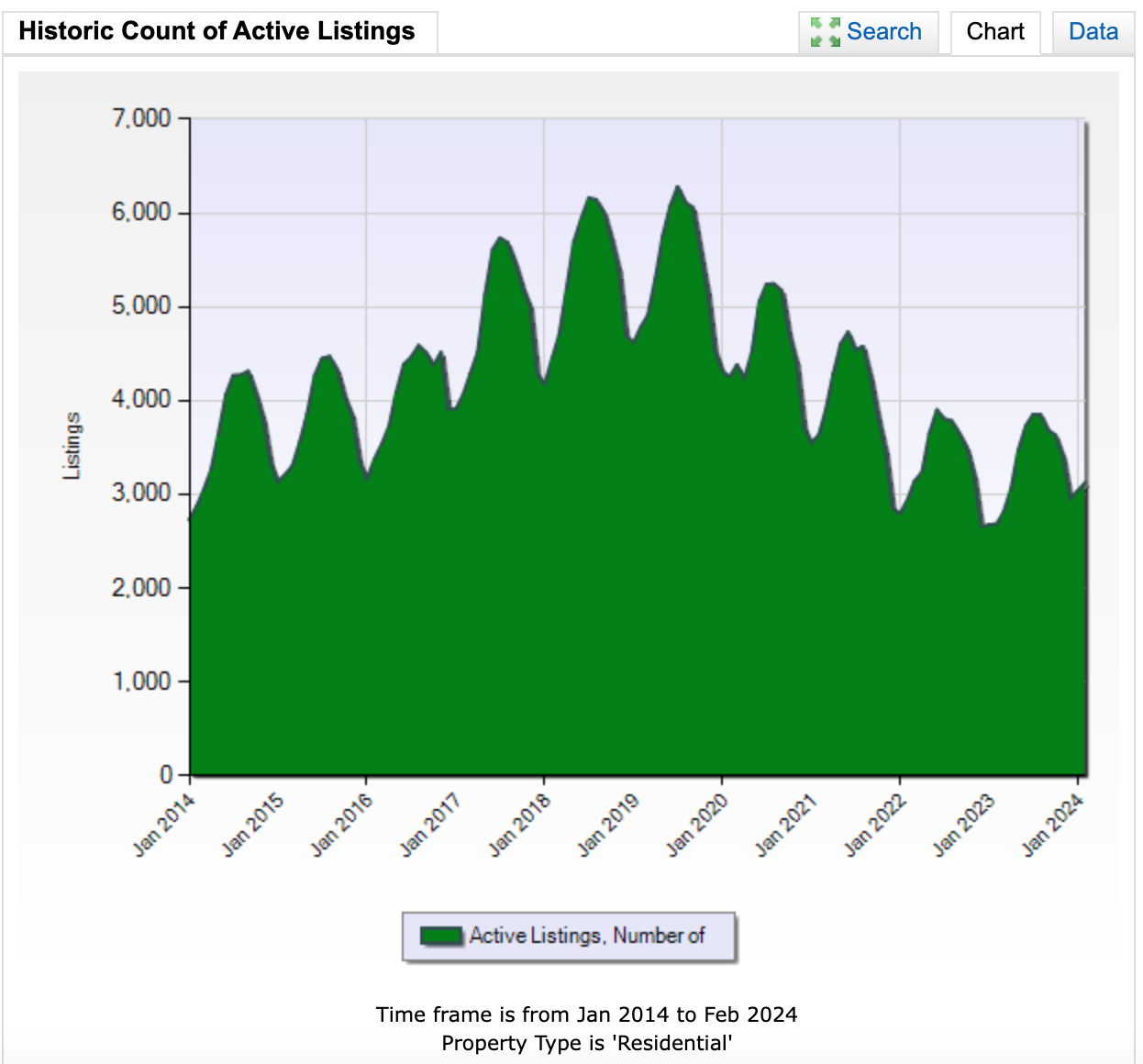
Active Listings & Average Sale Price Addressing raw data directly from the MLS, the numbers indicate a post Covid era drop that has not bounced back yet, as a result of a combination of economic factors mentioned in this post’s introduction. Quantifying the outcome, the St. John’s residential supply has taken an approximately 45% drop from the 10 year high of 15,752 listings, to around 9000 listings per year in 2023 & 2024.

Active Listings St. John's by Year

Boomer Housing While not the reason for the drop, I believe boomers hold one of the key solutions to the demand issue. In St. John’s, one of the most significant demographic groups shaping our housing landscape, job market, and overall economy is the baby boomer generation, which makes up approximately 20% of the local population. Point2Homes, an online real estate marketplace, reports that there are 49,255 households in the local housing market, and that 13,348 (27.1%) of those homes are primarily maintained by someone 65 years or older.

These homeowners, many of whom have lived in their properties for decades, are creating unique challenges—and opportunities - for the market. Many boomers in St. John’s own homes that were designed and decorated to their personal tastes years ago. While these homes may hold sentimental value and are perfectly functional for the owners, they’re often considered “dated” by today’s buyers. As a result, these homes don’t command the high prices homeowners expect when compared to smaller, newer properties that fit today’s trends. The problem for buyers is that there are not a lot of options when it comes to newer modern homes either, so they are willing to buy older homes if they became available, but they simply are not.

The consideration for boomer generation homeowners is easy to understand: Why sell a home they love, only to struggle to find a suitable, smaller property in a market where supply is tight and competition is high? Especially when they are comfortable in a house that is often largely paid off and was custom built for their preferences. Instead, many choose to stay put in their larger homes, continuing to maintain the properties as best they can, for as long as they can. Until they simply cannot anymore - usually due to health conditions and general aging. 

The Rental Option: A Growing Trend

Major developers and investors in St. John’s seem to have noticed this trend and are responding by building multi-family units. Data from the Canada Mortgage and Housing Corporation indicates that in the St. John's Census Metropolitan Area, multiple-unit housing starts totalled 323 units from January to December 2024, representing a significant 129.1% increase compared to the 141 units recorded during the same period in 2023. 

Luxury rental developments like One Churchill Park, Star of the Sea Residences, Macpherson Suites, MIX Apartments, and Regency Towers are quickly becoming the go-to option for developers catering to the boomer market in St. John’s. As baby boomers look to downsize from traditional homeownership while maintaining a high standard of living, these upscale rental communities provide the perfect balance of comfort, convenience, and modern amenities. Offering features such as spacious layouts, high-end finishes, fitness facilities, social gathering spaces, and underground parking, these developments appeal to retirees and empty nesters seeking maintenance-free living without sacrificing quality or location.

KMK Capital is continuing the trend by planning another large apartment complex on the site of the former Max Athletics building in the east end. This upcoming project is expected to further solidify luxury rentals as a preferred housing option for boomers who want to enjoy a lock-and-leave lifestyle while staying within established, amenity-rich neighborhoods. With a shifting real estate landscape and increasing demand for premium rental accommodations, developers are strategically positioning these high-end apartment complexes to attract a demographic that values both luxury and long-term flexibility.

What Happens When Boomers Finally Sell?

Over the next 10-15 years, as boomers transition out of homeownership, we could see a significant wave of properties hitting the St. John’s market. At first glance, this might suggest an oversupply scenario, leading to downward pressure on prices. However, if demand remains strong—driven by solid economic planning, steady in-migration, and continued interest in the local real estate market—this generational shift could play out in a way that rewards early sellers rather than causing a broad price correction.

Those boomers who choose to list their homes sooner rather than later may benefit from the current supply shortage, where eager buyers are still competing for limited inventory. With pent-up demand already driving market activity, the first wave of sellers could see multiple offers and premium pricing, capitalizing on an environment where buyers have fewer choices. However, as more boomers list their homes in the years to come, the initial supply crunch could ease, reducing the urgency among buyers.

Boomers who wait too long may find themselves in a more balanced or even buyer-favored market, where the influx of similar properties provides more options and dampens competition. This shift wouldn’t necessarily crash prices, but it could mean longer selling times and the potential for softer negotiations. The key takeaway? Those looking to maximize their home’s value may want to act sooner rather than later while demand remains intense and supply remains constrained.

What Does This Mean for Buyers and Sellers?

If you’re a current homeowner or potential buyer in St. John’s, understanding this trend is key. Here’s how it could impact you:

1. For Boomers: If you’re considering selling your home, now might be a good time to plan your move while demand remains strong and supply is limited. Waiting too long could mean competing with a flood of similar listings in the future.

2. For Buyers: Keep an eye on how the market evolves. As boomers begin selling their homes in larger numbers, you may find more opportunities to purchase spacious, affordable properties—especially if the market shifts in your favour.

3. For Investors: The growing rental market could present opportunities for those looking to invest in multi-family developments or renovate dated homes to meet modern buyer expectations.

The Bottom Line

The boomer generation is shaping the St. John’s real estate market in ways that will continue to unfold over the next decade. As trends shift - whether through downsizing, transitioning to rentals, or an eventual increase in available homes - it’s essential to stay ahead of the curve. No matter where you find yourself in the market, I’m here to help you navigate the changing landscape, ensuring you make informed decisions that align with your long-term goals. If you’re looking for guidance in this evolving market, let’s have a conversation - I’d be happy to help.

Read

Trade War and the Housing Market: Understanding the Shift

Trade War and the Housing Market: What It Means for St. John’s

With new U.S. tariffs on Canadian imports now a reality, homeowners, buyers, and investors in St. John’s may be wondering how these economic shifts will impact the local housing market. Higher costs for building materials like lumber, steel, and aluminum could create challenges, but they also open up strategic opportunities for those who stay informed.

As a real estate professional in St. John’s, I want to break this down so you can navigate these changes with confidence. Let’s explore what’s happening, how it could affect our local real estate market, and what you can do to stay ahead.

How Trump’s Tariffs Could Affect Housing in St. John’s

The U.S. has imposed 25% tariffs on various Canadian goods, which will drive up costs for essential materials used in home construction and renovations. Here’s how this could play out locally:

- Higher Costs for New Homes & Renovations – Builders and contractors in St. John’s are already dealing with increased material costs, which may push new home prices higher and make renovations more expensive.

- Potential Slowdown in Construction – Higher costs could discourage new housing developments, leading to fewer options for buyers looking at new builds.

- Uncertainty in Key Industries – Newfoundland and Labrador’s economy, with its reliance on natural resources, could see some indirect effects from trade disruptions, potentially influencing job growth and consumer confidence.

However, Newfoundland’s real estate market doesn’t mirror larger, high-growth cities like Toronto and Vancouver. That’s where opportunities arise for buyers, sellers, and investors who understand these shifts.

What This Means for Sellers

With new home construction potentially slowing due to rising costs, existing resale homes will become more attractive to buyers looking for affordability and stability. This could mean stronger demand for well-maintained homes in St. John’s.

🔹 If you’ve been thinking about selling, now could be an ideal time. Continued low competition from new builds means your home could be one of very few viable options on the market for a buyer. And, if priced strategically, buyers frustrated with the lack of available supply are prone to making emotional decisions that could result in more money for a seller.

Opportunities for Buyers

While the cost of new homes may rise, buyers looking at resale properties may find themselves in a more favorable position. Some prospective buyers may hesitate due to economic uncertainty, which could create opportunities for those ready to act.

🔹 Interest rates remain a key factor. If the Bank of Canada continues to adjust rates downward, mortgage affordability could improve despite other financial pressures.

🔹 If you’re a buyer, this could be a great time to purchase before demand shifts again.

Smart Renovation & Investment Strategies

For homeowners considering renovations or investors upgrading rental properties, it’s important to be strategic:

✅ Lock in contracts early. If you’re planning renovations, securing materials and labor costs now can help avoid further price increases.

✅ Focus on high-impact upgrades. Kitchens, bathrooms, and energy-efficient improvements tend to offer the best return on investment.

✅ Consider financing options. If interest rates remain low, home equity loans or lines of credit may be an affordable way to finance renovations.

How to Navigate the Market Moving Forward

The real estate market is always evolving, but opportunities exist for those who stay informed and act strategically. Whether you’re looking to buy, sell, or invest, it’s crucial to adapt to these changing conditions with a clear plan.

📩 If you’re wondering how these changes might affect your real estate goals, let’s chat. I can provide expert insights and personalized advice to help you make the best decisions in today’s market.

Let’s navigate this together—reach out today!

Read

The Two-Apartment Frenzy in St. John’s: What Buyers and Sellers Need to Know

You’ve heard the stories. Rumours. LEGENDS! Maybe it was a braggadocious social post by a Realtor®, or perhaps a friend talking about how they sold their home with double-digit offers. But most likely, you’ve heard it from a dejected buyer, complaining about how they can’t seem to win a competitive offer situation—there are far more of those people than you might think.

If you’re considering buying a two-apartment home in St. John’s, it’s time to take a serious look at what’s happening in the market so that you don’t become one of those frustrated buyers, getting increasingly emotional with every lost opportunity. And if you have one or more rental properties in your investment portfolio, the information below goes beyond the anecdotal, providing quantifiable data you should consider when evaluating your investments.

2024 Market Performance: The Numbers Speak for Themselves

Based on recent MLS data, 2024 has been an incredibly competitive year for two-apartment homes in St. John’s—perhaps more than many realize!

Here are some key insights from last year’s sales:

  • A total of 414 two-apartment homes were sold in St. John’s in 2024.

  • 68% of those homes sold above asking price—a clear indicator of strong demand.

  • The highest over-asking sale in this category was 31.3% above asking, meaning the seller walked away with an extra $72,100 over list price.

  • The average over-asking sale resulted in a sale-to-list price ratio of 106%, meaning sellers received an average of 6% more than their asking price in competitive situations.

  • Speed was a factor: Homes that sold above asking spent an average of just 33.1 days on the market, while those that sold at or below asking took significantly longer at 51.3 days.

  • The median price per square foot was $171.25, reflecting a 25% increase over the five-year median value of $137.27 and a 12% increase year over year from 2023.

  • Median price per square foot of over-asking properties was $175.

2025 Trends: The Market Is Only Getting Hotter

While we are only in February, the data suggests that the two-apartment market in St. John’s is getting even more competitive:

  • 34 two-apartment home sales have been recorded so far in 2025.

  • 70% of these sales have gone over asking price, a slight increase from 2024’s already high 68%.

  • For properties selling at or over asking, the average sale-to-list ratio is 111%, with a median of 114%.

  • The median price per square foot has increased to $177.51, marking a 3.6% rise from 2024.

  • For competitive sales over asking, the median price per square foot is now $181.86, a 4% increase for the most desirable two-apartment properties.

  • The median sale price for two-apartment homes that sold over asking has jumped 9.7%, from $399,450 in 2024 to $438,500 in early 2025.

With market supply at historically low levels and incredibly strong demand driven by homeowners seeking to offset living costs and investors recognizing the high ROI opportunities, 2025 is shaping up to be a record-breaking year for two-apartment homes in St. John’s.

How Does This Compare to the Single-Family Home Market?

The single-family home market is also highly competitive but not as intense as the two-apartment sector:

  •  1,118 single-family homes were sold in St. John’s in 2024.

  • 52% of these homes sold above asking price.

  • The highest over-asking sale was a heritage home on Rennies Mill Road, which sold for $1,200,000—60% over its $749,900 list price.

  • The average over-asking sale resulted in a 106% sale-to-list price ratio, mirroring the two-apartment market.

  • Homes that sold above asking spent an average of 34.0 days on the market, while those that sold at or below asking took 52.3 days.

What This Means for Buyers and Sellers

Buyers: Be Prepared to Act Quickly

  • Expect competition—many homes are selling for well over asking price.

  • Get pre-approved for your mortgage so you can move quickly.

  • Work with an experienced Realtor® who understands the fast-paced nature of this market.

  • Be ready to submit strong, competitive offers, potentially with fewer conditions.

Sellers: Now Could Be the Best Time to Cash In

  • Demand is high, and supply is limited. Listing now could allow you to capitalize on high buyer interest.

  • Strategic pricing and property preparation matter. Proper staging, minor upgrades, and competitive pricing can maximize your return.

  • Investors should consider whether to sell or hold. With rising rents and increasing home values, now is an excellent time to reassess your portfolio.

Final Thoughts

The two-apartment home market in St. John’s is experiencing unprecedented demand, and the numbers prove it. Whether you’re a buyer looking to secure a property that can help offset living costs, or an investor evaluating the best time to buy or sell, understanding the current market dynamics is crucial.

With over 15 years of experience as a full-time professional Realtor®, I have been consistently recognized for my service and sales excellence, and, for the past two years, I have held the title of top-performing solo agent in St. John's for Keller Williams Platinum Realty. With my experience and knowledge of the market on your side, you can feel confident in the decisions you make about your real estate. Here’s what one of my clients had to say:

“Andrew is the epitome of professionalism! He is always prepared, he always makes time and he always dedicates 100% energy to his clients. If you are looking for someone who will go well beyond the norm, Andrew will not disappoint." - Lynn Squires

Reach out today to chat about keeping you ahead in such a fast paced and aggressive housing market.

Read

“Own a cottage or investment property? Here’s how to navigate the new capital gains tax changes”

This article was written by ROB CARRICK, Personal Finance Columnist at the Globe and Mail, published April 22, 2024.

New rules for taxing capital gains mean quick decisions are required for cottages that families have owned for decades, and investment properties as well.

Until June 24, you can sell a second property or cottage and pay tax on just half your capital gain, however much it is. After that date, the recent federal budget proposes to increase the inclusion rate on capital gains greater than $250,000 to two-thirds. Capital gains of this size can easily be envisioned in the property market after the massive price gains of the past 10-plus years.

“From now until June, we might be seeing some hasty sales to bypass the increase in capital-gains tax for those people who have held a property for long enough to realize that gain above $250,000,” said Diana Mok, adjunct professor at the University of Western Ontario and an expert on real estate finance.

But maybe you don’t want to rush into anything. Historically, the capital-gains inclusion rate has many times been adjusted up and down. The rate went from half to two-thirds in the late 1980s and then up to three-quarters from 1990 to 1999. In 2000, it was chopped back to two-thirds and then again to 50 per cent.

The next opening for a change would be after the next federal election, which is expected by fall of 2025 unless the minority Liberal government falls earlier. People may want to hold on to secondary properties until after that election. “I think this is a huge reason that people will be focused on the Conservative Party,” said Lani Stern, broker and senior vice-president of sales at Sotheby’s International Realty Canada.

Mr. Stern said he’s advising clients to sell only if they already had plans to do so. The federal government’s budget documents suggest there’s an expectation of a bulge of capital gains-generated tax revenue in general this year as people try to get ahead of the higher inclusion rate.

A capital gain is the difference between the purchase price of a home, stock or other asset and the sale price. The inclusion rate is the portion of the gain that is taxable. Currently, the 50-per-cent inclusion rate on a $500,000 capital gain means a taxable gain of $250,000.

The taxable amount of a $500,000 gain under the new rules would be $291,750. That’s $125,000, or 50 per cent of $250,000, plus $166,750, which is 66.7 per cent of the other $250,000 portion of the $500,000 gain.

Your margin tax rate would determine how much tax you actually pay on these gains.

Draft legislation for the new capital-gains rules has yet to be issued. But John Oakey, vice-president of taxation at Chartered Professional Accountants of Canada, said he believes it will be possible for capital gains to be split on the sale of properties co-owned by spouses. Each spouse would be able to report up to $250,000 in capital gains at the 50-per-cent inclusion rate.

The higher inclusion rate was billed in the budget as a way of targeting high-net-worth individuals, but middle-class families could be caught up as well in selling family cottages bought decades ago at a fraction of their current value. A principal residence can still be sold tax-free, but the gain on a cottage or investment property is taxable.

“Whether/when to transfer cottages to the next generation is a perennial question for many Canadians,” Andrew Guilfoyle, partner at Chronicle Wealth, said by e-mail. “The time crunch could make this much more difficult to execute versus simply realizing capital gains in an investment account of public stocks, as there will be legal documents and valuations needed.”

Prof. Mok sees the impact of the higher capital-gains inclusion rate being felt more by long-term investors than those who are flipping properties. “I could hardly see even the hottest market in Canada, such as Toronto, gaining $250,000 within a year or two,” she said.

Longer-term real estate investors will adjust to the higher tax rate, Prof. Mok predicted. Her thinking on this is influenced by what happened in Toronto after the introduction of a municipal land-transfer tax in 2008. Some observers thought house prices would cool down or fall, but that never happened. Similarly, people will adjust to the new capital-gains tax rate.

Read

Real Estate Awards: Why do they matter to you, the client?

Last month, I shared some exciting news with all of you, having been honoured with the Double Gold Medallion award for outstanding sales performance as a real estate agent with Keller Williams for 2023! Additionally, I was recognized as the top-selling solo agent in St. John's for our company in 2023, further highlighting the dedication and expertise I bring to every transaction.

In the past, I have been critical of real estate awards. My main criticism has always been regarding the significance, or lack thereof, of the moniker “award winning Realtor”, as the standard to achieve an award is not the same across companies, and the companies setting those achievement standards have a vested interest in seeing a large portion of their agents achieve the status - more award winning agents, the more prestigious your company is in the public eye, right?

But, in reflecting on this post, I have softened my cynicism quite a bit, and believe that real estate awards do have a role to play in the real estate industry. However, I will not back down on my opinion that we do not need lengthy, Oscar-esque acceptance speech style social media posts to celebrate receipt of accolades.

So why should you, as a client or potential client, care about real estate awards won by an agent? The short answer is it should be used as a partial means for evaluating an agent you would like, or continue, to work with. Partial is key: I suggest you take it with a grain of salt, recognizing that a lot of awards are given out to celebrate achievement at a variety of levels, take into consideration the agent’s time in the business, and other factors about their areas serviced and competition level in those regions. If you better understand the significance that the award represents for the individual agent, it will become a more valuable tool for evaluating if an agent is the right fit for you. 

Let's dive into why these awards are important tools for informing your opinion of an agent.

Recognition of Excellence

First and foremost, awards like the Double Gold Medallion are a mark of excellence in the real estate industry. They signify a high level of performance, which indicates that I have consistently gone above and beyond, exceeding expectations and delivering exceptional results. As a client, knowing that your agent has been recognized for their excellence can give you confidence and peace of mind.

In the hierarchy of KW awards, there are 4 tiers of Gold Medallion, then Platinum and Double Platinum. There were two solo agents who achieved a higher status than I did, but they were operating in rural areas of the province. Outside of that there were three teams that finished above my performance. That is out of 90+ agents, so you can readily see that I am at the top of my game amongst my Keller Williams peers. 

An agent who wins a Bronze level status, while not performing as well as I am on the sales/gross commission income scale, may still be a good fit for a client. For example, a young agent, who is in their first year of their business might be viewed as having exceptional skills to achieve any award status in such a competitive business and such a short time frame. Young award winning agents are the up and coming talent pool and may represent exceptional qualities that far exceed the abilities of an older, more experienced agent - this has been very true over the past decade with respect to young agents and their use of technology in the field vis a vis industry veterans who were not able to adopt technologies as well. 

Trust and Reputation

Awards and accolades contribute significantly to building trust and establishing a strong reputation. When you work with an award-winning agent, you know that you're partnering with someone who has a proven track record of success. This can be especially reassuring for new clients who may be entering the real estate market for the first time or looking for an agent they can rely on.

Industry Knowledge and Expertise

Earning awards like the Double Gold Medallion requires high level performance that hinges on a deep understanding of the real estate market, excellent negotiation skills, and a commitment to staying updated on industry trends. By choosing a top level award-winning agent, you benefit from their expertise and insights, ensuring that you make informed decisions throughout the buying or selling process.

Continued Commitment to Excellence

Receiving these awards is not the end goal but rather a motivation to continue striving for excellence. As a client, you can expect the same high level of dedication, professionalism, and personalized service that has earned me these accolades. Your satisfaction and success remain my top priorities.

In conclusion, winning awards like the Double Gold Medallion and being recognized as the top-selling agent in St. John's is not just about receiving a trophy; it's about the values, expertise, and commitment that underpin every interaction and transaction. Whether you've been a client in the past or are considering working with me in the future, I am dedicated to delivering exceptional results and helping you achieve your real estate goals.

Thank you for your continued support, and here's to many more successes together!

Read

BoC Holds Rate, but What Happens When the Expected Fall Does Happen?

As expected by most economists, with today’s rate announcement the BoC held held its key lending rate at 5% for the fifth consecutive time. These announcement dates have become quite a big deal with many Canadians on the edge of their seats, with speculation running high that a rate cut may be on the horizon by mid-year. While the potential benefits of lower interest rates often spark optimism, it's crucial to consider the potential impact on the Canadian housing market, especially if this reduction isn't accompanied by an increase in housing supply.

Lower interest rates typically make borrowing more attractive, encouraging prospective homebuyers to enter the market. This surge in demand, however, can lead to increased competition for available homes, potentially driving prices upward. If the demand outpaces the supply – a scenario that may unfold with a rate cut unaccompanied by increased housing inventory – the Canadian housing market could experience further strain.

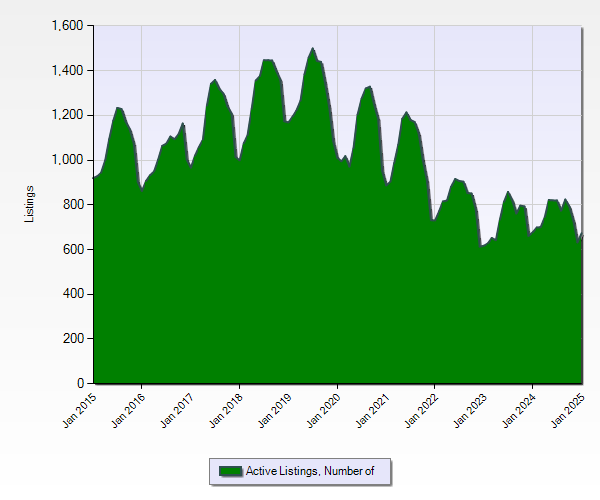
As the charts below demonstrate, supply in Newfoundland is at a 10 year low, demonstrating an obvious dearth in the post-covid era that shows no sign of recovery at the moment. 

NLAR January Supply

Housing Affordability Challenges

While reduced interest rates can make homeownership more financially feasible for some, the lack of a corresponding increase in housing supply may exacerbate affordability challenges in certain regions. As demand intensifies, especially in popular urban areas, prospective buyers may find themselves facing higher prices and limited options.

For real estate investors, the changing market conditions may present both opportunities and challenges. An influx of buyers could potentially drive up property values, benefiting those with existing real estate holdings, as increased demand without a corresponding rise in supply could lead to more competitive bidding situations. We saw similar market reaction with a significant increase to the residential average price post-covid, which has levelled off due partially to interest rate control measures. 

Insights Looking Forward

As Canadians await the Bank of Canada's decisions in the coming months, it's essential to stay informed about the potential implications for the housing market. While lower interest rates can be a catalyst for economic activity, a thoughtful and coordinated approach to addressing housing supply issues is equally critical to ensure a balanced and sustainable real estate landscape. Homebuyers, sellers, and investors alike should monitor market developments closely and be prepared to adapt to the evolving dynamics of the market. I suspect that when interest rates do begin to tumble, it will be a slow decline compared to how quickly they increased, and that the market supply will have time to react to any increased demand.

But if the construction industry is not supported by government initiatives to mitigate supply issues, market dynamics will likely dictate a stabilization of interest rates at elevated levels like we are seeing today as a means to control housing prices. I’m not confident that is a great long term solution. 

Read

Are New Homes Always Better Than Older Ones? A Case for “Good Bones”

In the relentless pursuit of progress, we often find ourselves enchanted by the allure of the new and improved. However, when it comes to the structural integrity of our homes, there's a compelling argument to be made for the enduring quality of mid-20th century lumber. In this era of fast-paced construction and modern materials, the saying "newer isn't always better" holds some water, and the decline in the quality of contemporary lumber should be a consideration for buyers and the longevity of their investment that may have you thinking about the pre-1980s home with “good bones” more seriously.

Timber Transition

The shift in lumber quality can be traced back to the 1980s when old-growth timber, known for its exceptional strength and durability, was nearly depleted. This marked the beginning of an era where the wood used in construction began to lose its intrinsic robustness. As a result, the lumber industry turned to fast-growth wood, harvested from young trees cultivated for rapid production.

One need only take a glance at a piece of mid-20th century lumber compared to its modern counterpart to observe a stark contrast. The older wood boasts a denser composition, displaying tight growth rings and a rich colour indicative of slower growth. In contrast, contemporary lumber often appears lighter and less dense, betraying its rapid growth origins. This difference in density has profound implications for the overall strength and longevity of the wood.

One of the key drawbacks of modern lumber lies in its scarcity of heartwood. Slow-growth wood, characteristic of mid-20th century lumber, yields a more significant amount of heartwood – the central, densest, and longest-lasting part of the tree. In contrast, newer lumber, grown rapidly for quick harvesting, lacks sufficient heartwood. This deficiency makes modern wood more prone to rot, significantly diminishing its lifespan compared to its older counterpart.

Termite Troubles

Another challenge with contemporary lumber is its increased susceptibility to termite damage. The softer nature of fast-growth wood renders it an easier target for these wood-consuming pests. In contrast, mid-20th century lumber, often resinous and naturally termite-resistant, stands as a testament to the benefits of using older, more robust materials in construction.

Investment in the Ages

Despite the allure of shiny new builds, there's a compelling argument for the longevity and resilience of homes constructed in the mid-20th century. With proper updates to plumbing and electrical systems, these vintage abodes represent a solid investment. The robustness of the lumber used in their construction often ensures that these homes will outlast their newer counterparts, offering not only a sense of nostalgia but also a practical and lasting choice for homeowners.

Good Bones = Selling Advantage

In the current market, the dearth of supply often results in buyers turning to new construction, and the steep costs of a custom build. Having an agent who understands the advantages of older homes and the ability to readily communicate those advantages to buyers can be critical for producing a successful sale. On the selling side, I always find an angle to maximize your return, and for my buying clients, this type of consideration can give you options when other competitive buyers don’t see that they have any. 

Navigating the real estate process is tricky, but it gets easier with an experienced agent by your side. If you’d like to chat about your real estate goals, it all starts with a conversation. Reach out any time to discuss your real estate.

Read

The Power of a Larger Deposit When Selling

In the world of real estate, negotiations between buyers and sellers are a delicate dance, and one of the key elements that can significantly impact the outcome, but is often overlooked in the initial negotiations surrounding an offer, is the deposit. As an agent representing a vendor, advocating for a larger deposit can be a strategic move with numerous benefits, but inertia in the St. John’s marketplace has prevented this from becoming commonplace, with deposits sitting generally at $1,000 on most transactions. In this blog post, I will outline some of the reasons why requiring a larger deposit is beneficial for my selling clients, and discuss how the resistance to deposit increase impacts the decision on when to push for a larger deposit and when to go with the flow.

WHAT IS A DEPOSIT?

People often confuse a deposit and a down payment. While they're both upfront costs in the home buying process, the two terms are entirely different. A deposit is money you attach to an offer to show a home seller that you're interested in buying their property. A down payment is a percentage of the home price you pay upfront, at time of closing, to close the purchase of a house. Across Canada, the anecdotal average deposit is 1% of the purchase price, and a deposit is credited toward your down payment upon closing. A down payment will be at minimum 5% of the purchase price and is due at closing. 

WHY SIZE MATTERS!

1. Demonstrates Buyer Commitment: 

A larger deposit is a tangible sign of a buyer's commitment to the property purchase. By putting down a substantial amount of money upfront, the buyer is signalling that they are serious about the transaction. This commitment can help reduce the likelihood of the buyer backing out of the deal, providing the vendor with a more secure position.

2. Negotiating Power at Inspection: 

A larger deposit gives the vendor and their agent increased negotiating power, especially on home inspection matters. Inspections are typically conducted within 10-14 days of acceptance of an offer, and are intended to find deficiencies with the home that can be either disregarded, addressed by the seller, or compensated for in lieu of the seller completing repairs. A seller can feel held hostage by a buyer who insists on marginal inspection deficiencies being addressed or compensated for if the purchaser feels they can walk from a deal with impunity, given the loss of their deposit would be marginal. A seller may give up more in home inspection negotiations than they otherwise would if the deposit was large, and the cost to the buyer was more significant for walking away. Small deposits increase a buyer’s negotiating power, while more skin in the game from the buyer increases the seller’s bargaining position. 

3. Financial Stability and Qualification: 

Requiring a larger deposit often means dealing with financially stable buyers. Buyers who can afford to put down a substantial deposit are more likely to have the financial means to complete the purchase. This can save time and effort for both parties, as dealing with financially qualified buyers reduces the risk of the deal falling through due to financing issues.

4. Protects Against Buyer Default: 

In the unfortunate event that the buyer defaults on the contract, a larger deposit may provide somewhat of a financial cushion for the vendor. This can help cover any damages or losses incurred during the process of re-listing the property. Having a substantial deposit also provides the vendor with more options and resources to pursue legal remedies if necessary.

5. Enhances Perceived Property Value:

In competitive offer situations, requiring a larger deposit can positively influence the perceived value of the property in the eyes of potential buyers. It suggests that the property is in high demand and that serious buyers are willing to invest a significant amount upfront. This perception can attract more interest from potential buyers and create a sense of urgency, potentially leading to a faster sale.

DEPOSITS IN THE ST. JOHN’S MARKET

Given all of these benefits, why wouldn’t sellers’ agents be pursuing larger deposits for all contracts? It is hard to say for certain, but some explanations might be related to not wanting to rock the boat on a potential deal by pushing for a large deposit that is perceived to be outside the norm in the industry. Additionally, many agents view deposits as nothing more than meaningless formalities. When a deal does fall apart, a vendor can threaten to keep the money all they like, but in most cases they still want to proceed with obtaining a sale, and the quickest and most affordable way to do that is often simply to sign a deposit release form, returning the marginal deposit money back to the purchaser, and moving on promptly.

There is also a sensitivity to affordability in general in the St. John’s market right now, with inflationary pressures on shelter pushing buyers to their brink. Agents don’t want to be the ones who attempt to forge forward individually with aggressive new deposit standards that may negatively influence a buyer’s opinion of a potential property of interest, however, that type of reaction would be extreme and unlikely in my opinion.

Overall, I believe the increase to deposits would be a beneficial for our industry as a whole, increasing the reliability of sales, while making transactions more predictable. While it may require some finesse during negotiations, the benefits for the vendor make it a worthwhile strategy, especially in the current hyper-competitive real estate landscape. But, until the industry moves forward as a whole with a policy on deposit increases, I will continue to take an ad-hoc approach to deposits with my selling clients to determine what is the best means for advancing their needs. 

Read

Interest Rate Holds at 5%

The latest rate announcement from the BoC was made this morning and they have decided to hold steady at 5%. This is welcomed news for most Canadians, especially those with mortgage renewals and new purchases on the horizon, but the governor of the Bank, Tiff Macklem, indicated that now is not the time for discussions about rate cuts. He also noted that inflation numbers are still elevated and there is risk that the conflict in Gaza will expand to include more regional actors, potentially reducing supply of oil to international markets, which would elevate the price of a barrel of oil and thus the cost of everything else in response. Interest rate hikes remain the Bank’s primary instrument for combatting such inflationary circumstances.  

The next and final announcement for 2023 will be on December 6.

Timing your market action, either to buy or sell, is certainly impacted by the direction of these announcements. For customized, personal advice, reach out to me any time to discuss your real estate decision making.

Read

2023 First Time Home Buyer Program Details Announced - Down Payment Coverage & Closing Cost Assistance

Details have just been announced about two parts of the NL government’s five part plan to improve affordable housing in the province. These two policies are directed toward assisting first time homebuyers (FTHB) with their down payment and closing costs. Summarized, FTHB will be able to apply for:

  1. a repayable loan up to five percent of the purchase price of a new or existing home, to a maximum purchase price of $350,000 in St. John’s.

  2. a grant of 50% of the legal closing costs up to a maximum of $1,500.

Important facts to know:

  • Eligibility will be based on incomes under $95,000, with between $85,000 and $95,000 seeing loan amounts reduced on a sliding scale.

  • There will be 150 applicants successfully supported by these policies. 

  • Down payment assistance loans will not have to be repaid for 5 years from time of purchase. 

  • Closing cost grants match the Federal program, which means FTHB could see up to $3000 contributed by government toward closing costs.

  • Program application will open November 1, 2023

Without question, this is an incentive that anyone thinking about a first home will need to explore, as a down payment assistance program like this will allow people the ability to enter the housing market without having the 5% savings already made. For those buyers who already have their down payment saved for, allowing them to keep their savings and schedule for gradual repayment of the loan in time will positively impact their financial stability. And finally, with $3000 available between federal and provincial funding for closing costs, a fully funded grant could offset roughly 60% of the expected closing costs, leaving buyers with more money in their pockets. 

If you are a first time buyer looking for more information about this newly minted program, send me a message today - I can help answer any questions you might have and take the mystery out of the process of buying your first home!

Read

What’s happening in the market today?

Top Dollar Real Estate Group Presents

Top Dollar Real Estate Group offers a monthly or quarterly report on local real estate market trends, including average home prices, inventory levels, and market forecasts.

What’s happening in the market today?

What’s happening in the market today?

Top Dollar Real Estate Group Presents

Top Dollar Real Estate Group offers a monthly or quarterly report on local real estate market trends, including average home prices, inventory levels, and market forecasts.

What’s happening in the market today?

Contact

HERE TO HELP

Let me know how to reach you and I'll be in touch to discuss your real estate. 


Contact Form

The trademarks REALTOR®, REALTORS®, and the REALTOR® logo are controlled by The Canadian Real Estate Association (CREA) and identify real estate professionals who are member’s of CREA. The trademarks MLS®, Multiple Listing Service® and the associated logos are owned by CREA and identify the quality of services provided by real estate professionals who are members of CREA. Used under license.
Powered by: REALTOR.ca